173
CAMPIONATO ITALIANO FORMULA 3 > 2010
prima di dare corso ad una nuova evo-
luzione tecnica e sportiva, non esisterà
nell’albo d’oro del Campionato Italia-
no. Ma questa è un’altra storia.
1964
TECNICA
Forte del dominio in Formula Junior,
la De Sanctis è pronta ancor prima
del Campionato. La Formula 3 del
con grande successo, l’inglese Jonathan
Williams che proprio grazie ai succes-
si in Formula 3 convinse Enzo Ferrari
ad offrirgli la possibilità di disputare
il Gran Premio di Formula del Messico
1967 come pilota ufficiale. Dal 1964
al 1966 la crescita della serie tricolore
divenne esponenziale andando a deli-
neare la stessa identità della catego-
ria. I primi tre anni che fondarono la
storia del Campionato Italiano Formula
3 rappresentano il suo prequel, avvin-
cente e spettacolare. Il 1967, invece,
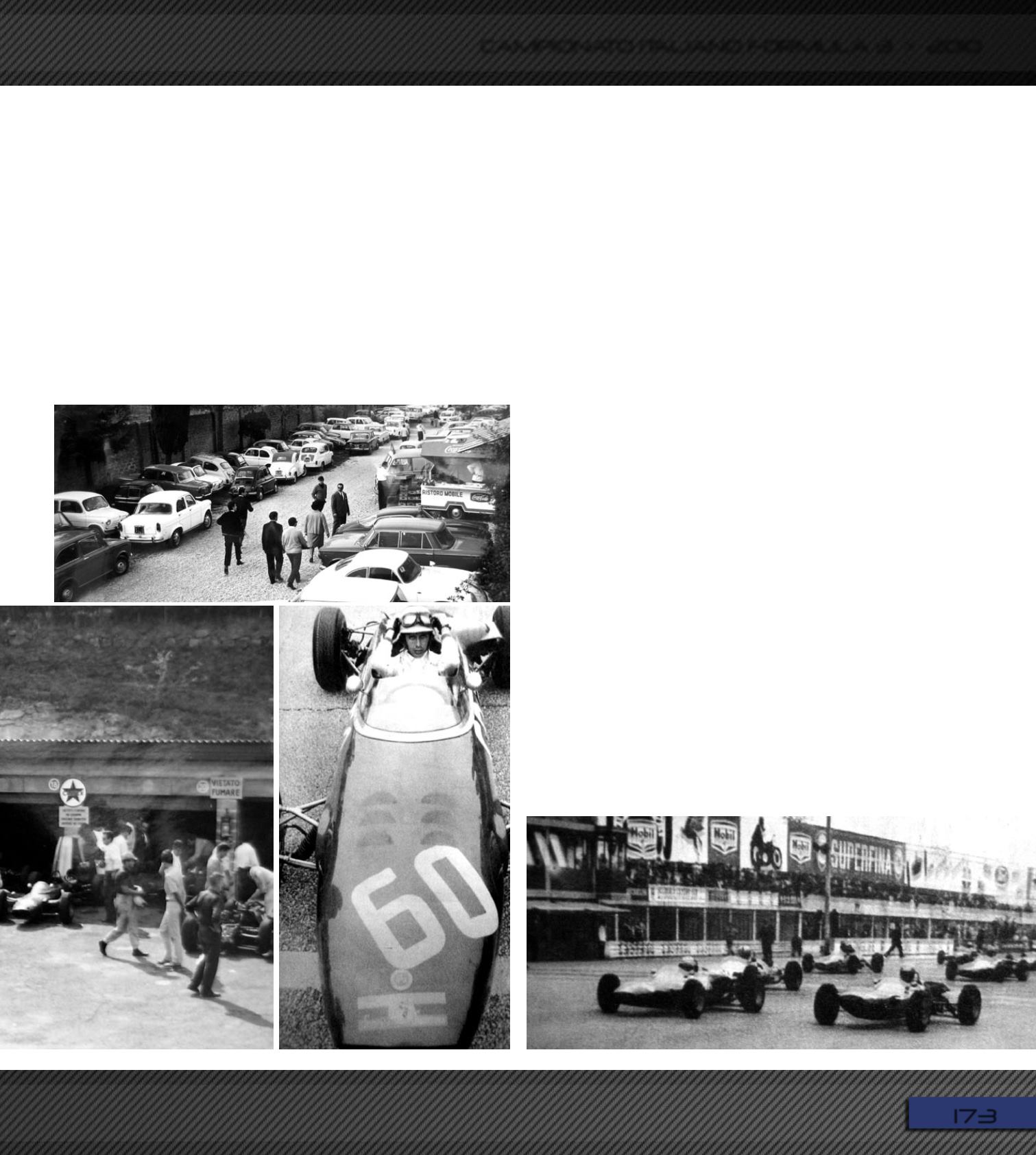
foto ARCHIVIO VALLELUNGA
serta, San Piero a Sieve, with sidewalks,
poles, houses, overflowing public. In
some tracks, not only street tracks, the
gravel caused by poor maintenance
forced drivers to bandage in order
to protect the face, otherwise bare by
only half helmets and combined with
the windproof glasses. Moreover even
the helmets arrived from America later
in those years would then only covered
up to the ears before the advent of the
“full-face”. Speed, however, and first
of all. The dimension of the driver, re-
ckless and unscrupulous, was percepti-
ble and even ostentatious. The most se-
ductive connotation in the attention of
the audience. Even so it was very strong
the matching to Formula 1 and the
public ldont’ miss the excitement of a
live event. The driver could be profes-
sional even with the only awards and
with the gigs. He was an entrepreneur
of himself. In the full sense, because if
he was not an official driver, the car
was owned by him, the team was at his
service. In 1964, Formula 3 was also
called “Formula 3 millions” “because
that was the price in Italian lira of the
first models. Soon grew to over 5 mil-
lion at the end of the ‘60s. More than
the price of a Ferrari. But who won a
Formula 3 race in the early years also
collected 1,000,000 lira, not counting
the gigs in some cases provided by the
organizers. A sum higher than the pri-
ce of a Fiat 124, the midsize sedan at
the time, so a value at least equal to
the current 20-25.000 euros. A winning
driver could do it for a living.
So Formula 3 Italian Championship was
born in 1964. Geki Russo and De San-
ctis Ford arrives in the series, after a
strong domain in Formula Junior and
they open the roll of honour. To follow
them until 1966, it will be Andrea de
Adamich, which will arrive later in For-
mula 1 and Tino Brambilla, unlike his
brother Victor, could not emulate his
predecessor. So many great protago-
nists in those years. Silvio Moser, Franco
Bernabei, Antonio Maglione, Carlo Fa-
cetti, Giancarlo Baghetti, who at that
time had already entered in the history
like the only winner of the Formula 1
Grand Prix at the debut, Clay Regaz-
zoni who soon after will jump in For-
mula 1 with great success, the English
Jonathan Williams who, just thanks to
the success in Formula 3, persuaded
Enzo Ferrari to offer him the chance to
drive Ferrari F.1 during the Grand Prix
of Mexico 1967. From 1964 to 1966
the growth of the series became expo-
nential going to shape the very identity
of the category. The first three years
that founded the history of the Formu-
la 3 Italian Championship represents
its prequel, exciting and spectacular.
1967, however, before to give the start
for a new technical and sporting de-
velopment, will not exist in the Italian
Championships roll of honour. But that’s
another story.
1964
TECHNICAL
After the strong supremacy in Formula
Junior, De Sanctis is ready before the
Championship. The Formula 3 of Roman
manufacturer is therefore derived from
F.Junior faithfully recovering the archi-
tecture. Weight of 410 kg. Only in the
VALLELUNGA
Gran Premio Roma
19-20 > 09 > 1964.
VALLELUNGA
Trofeo Luigi Musso
16-17 > 10 > 1965.
“Geki” Giacomo RUSSO
DE SANCTIS-FORD
Coppa Autodromo di Monza
05 > 04 > 1964


